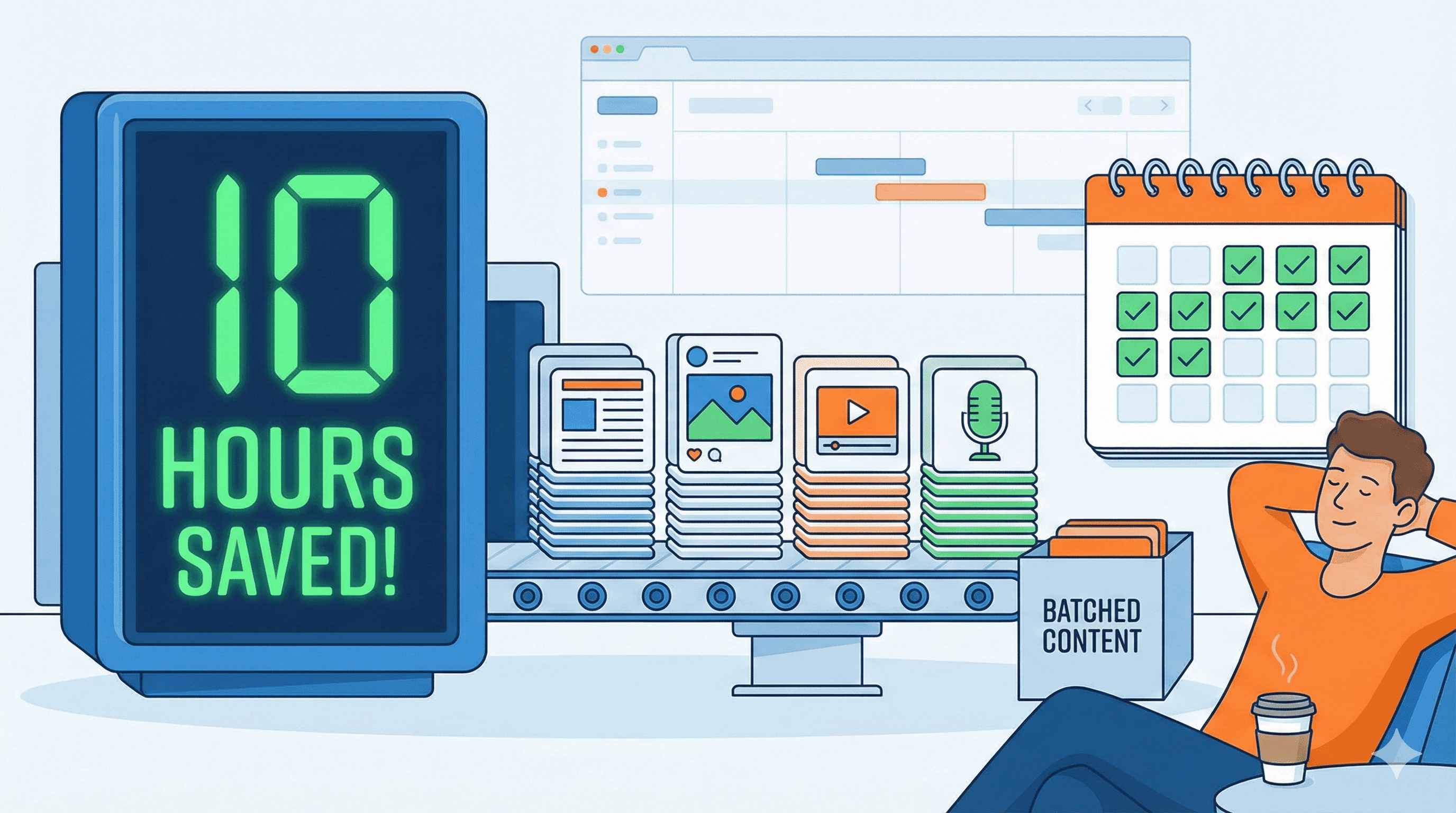
The number one reason creators quit is burnout. The pressure to "feed the beast" every single day—coming up with an idea, writing a caption, designing the graphic, finding hashtags, and posting—is exhausting. It’s a hamster wheel that never stops. But the most successful creators aren't working harder than you; they're working differently.
Enter Content Batching. Batching is the productivity hack of grouping similar tasks together to minimize "context switching." By dedicating focused blocks of time to specific phases of creation, you can produce a month's worth of content in a single day, saving you 10+ hours a week and preserving your sanity. This guide will walk you through a proven 4-step batching workflow.
The Science of Context Switching
Why does batching work? Because the human brain is terrible at multitasking. Every time you switch from a creative task (like writing) to an analytical task (like hashtag research) to a visual task (like designing), you pay a "cognitive tax." It takes time to get back into the flow. Research shows it can take up to 23 minutes to regain focus after an interruption.
Batching eliminates this tax by keeping you in one mode for an extended period. When you are in "writing mode," you can churn out 10 captions in the time it would usually take to write 2, simply because you are in the flow state.
Step 1: The Brainstorming Dump (1 Hour)
Start with a blank slate. Open a document or a spreadsheet. Set a timer for 60 minutes. Your goal is to write down 30 post ideas. Do not judge them. Do not try to refine them. Just get them out of your head.
Look at your content pillars (e.g., Education, Inspiration, Entertainment, Promotion). Aim for a mix. Review your comments and DMs for questions your audience is asking—these are gold for content ideas. Check your analytics to see what performed well in the past and brainstorm variations of those topics. By the end of the hour, you should have a raw list of topics.
Tools: Use tools like Trello, Notion, or a simple Google Sheet to capture these ideas. Keep an "Idea Bank" accessible on your phone so you can capture inspiration whenever it strikes during the week.
Step 2: The Copywriting Sprint (2 Hours)
Now, switch to writer mode. Take your list of 30 ideas and write the captions for them. Don't worry about the visuals yet. Focus purely on the message.
Use a framework like AIDA (Attention, Interest, Desire, Action) for your captions. Write your hooks. Draft your value points. Add your CTAs. Doing this all at once allows you to maintain a consistent brand voice and flow, rather than struggling to "find your voice" every morning. You'll find that by the 5th caption, the words are flowing much faster than on the 1st.
Pro Tip: Don't edit while you write. Just get the first draft down. You can polish and spell-check later. The goal is momentum.
Step 3: The Design Assembly Line (3 Hours)
This is where most people get stuck, but it's where batching shines. Open your design tool. Instead of starting from scratch for every post, use templates. Create a set of 5-10 master templates for different types of posts (quotes, lists, carousels, tweets, etc.).
Then, simply plug in your copy from Step 2. This assembly-line approach is incredibly fast. You aren't making design decisions for every pixel; you are simply populating a proven layout. This ensures visual consistency and speeds up the process by 5x. PostLab AI excels here, allowing you to generate variations of designs instantly.
Asset Preparation: Have your brand colors, fonts, and logo ready in your design tool. Organize your stock photos or personal photos in folders so you aren't wasting time searching for images.
Step 4: Scheduling and Automation (1 Hour)
You now have 30 captions and 30 graphics. The final step is to schedule them. Do not post manually every day. Use a scheduling tool like Buffer, Later, or Meta Business Suite.
Upload your media, paste your captions, add your hashtags (which you can also batch save as groups), and set the date and time. Once you hit "Schedule" on the last post, you are done. Your Instagram is on autopilot for the next month.
The Freedom of Batching: Imagine waking up in the morning knowing your content is handled. You can now spend your time engaging with your community, working on your business, or simply taking a break, without the guilt of "I haven't posted today."
Managing Burnout and Staying Flexible
Batching doesn't mean you can't be spontaneous. Leave room in your calendar for real-time stories or trending posts. If big news hits your industry, you can always pause a scheduled post and insert a timely one. Batching creates the foundation of consistency, giving you the freedom to be flexible without the stress.
If a full month feels too overwhelming, start by batching one week at a time. The principle remains the same. Dedicate Sunday afternoon to creating your content for the week. The mental clarity you gain is worth every minute invested.
Conclusion
Content batching is the professional's secret weapon. It shifts you from being reactive (scrambling to post) to proactive (executing a strategy). It saves time, improves quality through focus, and eliminates the daily stress of social media management. Give it a try for one month, and you will likely never go back to daily creation again.
Share this article
Spread the knowledge to your network